 Will I Ever Catch Up?
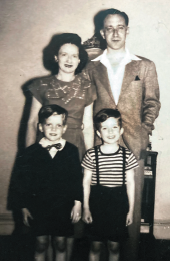
I fell behind from the get-go. Bags of groceries showed up, brought by my grandmother. Sometimes a Wonderbread and ketchup sandwich was all I could find to eat. Our cold-water flat kitchen had a bathtub against the wall covered by a board. The four kids were shooed out of the room whenever Mom or Dad needed a bath. My parents slept in the living room on a convertible sofa bed. My father would be out of work for months so he took employment as a Good Humor ice cream truck driver. Mom said the job humiliated him although I thought the job a neat one. Sometimes when my father did have work he would stop off at the local bar on paycheck day thus diminishing the amount for us to get by on. And when he didn’t have work for months, my mother had us get down on our knees and say rosaries so, “dad would find a job.” No job meant the family would have to be broken up among relatives.
My grammar school was a converted cheese factory. The Monday following Easter many
students wore their new holiday outfits. My mother scrounged from the church’s clothes bin a
second-hand gray suit that had wide, floppy pant cuffs that were too wide for me. I wore that
suit in the hallways walking as slowly as I could so the cuffs wouldn’t flap. The hippest guy,
Steve LePage wore black pegged pants with a pink insert running down the outside of each
leg. He bragged his dad was a G-Man, that I later learned meant he was a garbage man. Even
the garbage man’s son was better off.
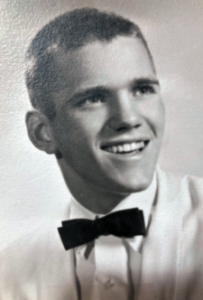 All of the above took place before I entered high school. I arrived the first day in my out of season flannel shirt with rolled up sleeves. Randy, an upperclassman, made fun of it. Myhigh school, in working class Union City, New Jersey, did not focus on preparing students
for college. Some attended college but there was little emphasis on college as a goal. Over the years the State Board of Education took over running our school system. The State Board had justification because among other problems, the Union City board appointed shop teachers as principals. The rumor in the hallways was that it took an $8,000 payment to land the job.
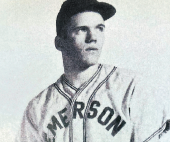
Throughout my high school years, I lived for sports. I could hit a baseball, score a touchdown and make a jumpshot. Playing these three sports was my focus. Baseball was probably my favorite as a player and a lifelong fan. I preferred to read box scores rather than read any lesson on history or geography. I barely studied and my grades showed it. But teachers cut me slack and I managed to move on to the next grade. Still, colleges came a calling. When I was offered a scholarship to the University of Vermont, I was informed I would have to take the SAT exam. Late, I scrambled to sign up and took it cold. Princeton showed interest, but said I would have to do a year at a prep academy to improve my SAT. With no one advising me, that was a no go since that meant I’d have to go to school an extra year. And who wanted that?
When I arrived at UVM, the class schedules and how to sign up and what major to declare baffled me. My roommate, Ron, also from Union City, returned from campus one day telling me that when he’d say, “how ya doin?” the preppies would reply, “I’m well.” We were perplexed because we would say, “ I’m good.” We couldn’t figure out when to say “well” or when to say “good.” Many of my new classmates had attended prep schools, knew upper classmen and knew the ropes. Their parents were doctors and lawyers. The first day of my freshman English class, I summed up an in-class essay by writing “The End.” My professor, Mr. Fasso, a new Harvard grad dressed in a tweed coat, a bow tie and wearing horn rimmed glasses, returned it to me with an F minus and this comment, “Yes, this is the end.” I saved that letter and it is in my attic. Mr. Fasso’s sarcasm was not a wake-up call. I stayed up late, skipped classes, studied little and wound up on academic probation. Although athletics were my crutch, underneath I felt small, insignificant and not up to the rigors of college.
But I did like college life so the second semester I attended classes and studied enough to
stay in school. I repeated this pattern of fail first semester and pass the second all four years.
I did not have any specific goal of what to do with an education or what career path I should
follow. It seemed that every other student had some idea of where he or she was headed, and
they seemed to have the skills to move ahead. As Spring Break rolled around, the preppies
were heading to Bermuda, and they kept asking me to join them. “Come on Frank, you’ll
love it.” Bermuda, shit, I had trouble catching a ride home to New Jersey.
But in college I did rub up against new ideas. I became fascinated with politics and interested
in world events. Two friends had been accepted into the Peace Corps. The notion of going
abroad to help others appealed to me. With little hope of acceptance, I filled out the Peace
Corps application and took a language test (they must have cut me some slack here).
Somehow I got invited to the 3-month training program for India in Athens, Ohio. The 44
trainees were an idealistic group of college grads from all over the country. As usual, their
pedigree made me think I was in over my head. But for the first time I was “all in.” Training
was an intensive, grueling boot camp of 12–hour days of studying Hindi-Urdu and acquiring skills such as well-digging and soakage pit building.
Numerous psychological tests were administered to see if we had what it took to handle the deprivation of India. And the program’s leaders artificially ramped up the pressure. Once they staged in the classroom a scenario of one student accusing his roommate of stealing from him.
Without being told, the class was expected to work it out. I guess the administrators were watching us for our reactions to a crisis. Then at the end of each month we were assigned times to go to our mailboxes. If there was a letter, it instructed us that we had moved on to the next phase. The odd thing was that we never saw the deselected trainees again. They just disappeared.
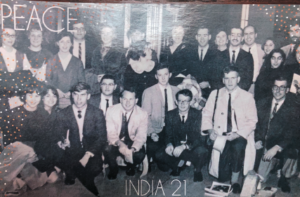 Same thing happened the second month. But after three months, I made it through along with the 26 other survivors. I would be a Peace Corps volunteer in India. I felt like I had caught up.
When I returned home after surviving the rigors of India (another story), I felt capable of finding my way in the world. I worked in President Johnson’s War On Poverty. I had met Sharon down the Jersey Shore four years before and reconnected with her. On our first real date I told her I had a feeling we were going to get married and she agreed. We then considered ourselves engaged! We married, traveled around the world for three months and moved to Boston for me to attend Suffolk University Law School. After I passed the Massachusetts bar exam, the idea of giving back took hold again so Sharon and I joined VISTA. We, with four-month old Shaanti in tow, wound up as volunteers at Legal Aid in East Austin. We loved Austin’s lifestyle so I took the Texas Bar Exam and was then hired at Legal Aid. Next, I secured a position at the U.T. Law School as staff attorney in a regional child abuse clinic. Then I worked as a juvenile defender sometimes representing kids who had committed horrible crimes.After 10 years in Austin we needed a change. Sharon and I moved to Spain in 1982 with Shaanti (9) and Jonathan (6). I had spent so much energy catching up and keeping up I was a complete burnout. When Sharon was hired as the director for the Center for Cross Cultural Study in Seville, Spain, I happily agreed to a midlife break and I enthusiastically assumed the househusband role.
Four years later, we returned to Austin where I practiced criminal defense law for 16 years and then retired in 2002. I let this writing class exercise sit for a while and then looked at it again. There was a certain self-congratulatory tone to my recounting. In this era of Black Lives Matter and the retelling of the history of racism in this country, I realized that I couldn’t take all the credit for catching up. My grammar school, my high school, my college and my Peace Corps group were lily white. By virtue of the color of my skin, I was provided with endless opportunities to catch up. But for most people of color catching up to a train that had already left the station became insurmountable no matter how hard they tried. I now know that all along the way I benefited from having my silent partner, my guardian angle, WHITE PRIVILEGE by my side and on my side.