 When I was eight years old, I came home from school on October 3, 1951, and the TV was on. My mother was watching the Giants-Dodgers National League’s pennant championship series. She didn’t know a thing about baseball, but a neighbor without a TV asked to watch the
game at our house. We lived in the Bronx, and back then, with the Yankees, Giants, and Dodgers, New York was the mecca of the baseball.
The Giants were tied with the Dodgers at a game apiece, and the winner would move on. In the last of the ninth, the Giants’ Bobby Thompson came to bat and hit a three-run homer off Ralph Branca—an unforgettable, euphoria-generating miracle now known as “the shot heard round the world.” Thanks to our television-less neighbor, I’d witnessed the most iconic homer in major league baseball history. I was now completely hooked on the sport.
One day, two years later, my mother came home from church and said the CYO would be taking parish kids to a Yankee game—all I had to do was meet the bus in the Bronz River park. I’d been dying to go to a game but we couldn’t afford tickets, so this was a dream come true for me. I got there early, and waited and waited. No bus came. I cried for the rest of the day, certain I’d never
get to see a major league game.
In 1954 my father landed a job at an atomic energy plant in Portsmith, Ohio and we relocated to nearby Sciotoville. With my Bronx accent, I was a minor celebrity to the local kids, and one of them invited me to a doubleheader, the Cincinnati Reds vs. the Milwaukee Braves. It was 100 miles of winding, one-lane roads away, and I got carsick.
But once we drove into the Crosley Field parking lot, and I saw the ballpark’s perfect base lines and manicured grass field, I was fine. The doubleheader turned into a slugfest with Ted Klazuski, Eddie Mathews and Wally Post slugging homers. There was a sign high up in left field outside the stadium advertising a men’s clothing store; if a homer hit that sign, the batter got a free suit. I think Wally Post’s homer won a suit? It was Hank Aaron’s rookie season, he went 5-5 in the second game, but broke his ankle sliding into third—the only significant injury of his 20-year Hall of Fame career. The Braves swept the double header 11-8 and 9-7, and I knew I would die happy now, having attended a major league game. I found out later that Aaron came up from the minors when Bobby Thompson who had been traded to the Braves broke his ankle in a Spring training game, and Aaron replaced him.)
In 1956 we moved to Union City, New Jersey. Walking home from school one day, I heard excited fan noise on a fruit-stand vendor’s radio and I stopped to listen. It was the World Series, Yankees vs. Dodgers, the bottom of the ninth. Vince Scully, the announcer, was reporting that Don Larsen had retired the last three Dodger batters for a perfect game. To this date, it was the only perfect World Series game.
I played on a Little League team. I remember getting my first spikes, a Spalding glove, my first uniform and the hat with our team name—Giants—embroidered on it. Our coach, Mouse, would rally us when we were behind in late innings by opening a beer in the dugout; one by one, we’d all bend down to take a swig. We won the championship that first season.
In 1957, the year before the Giants and Dodgers moved out West, I was invited to a game at the Polo Grounds to see the US All-Stars play the New York City All-Stars as a fundraiser for sandlot baseball. It wasn’t supposed to be a big deal, but it turned out to be a one. To boost attendance, there was a home run-hitting contest between Mickey Mantle, Willie Mays and Duke Snider. Each batter had ten swings. Willie Mays won, but Mickey Mantle hit a ball from the right side that I believe is still traveling. I don’t recall what the Duke did, but the three of them hit a total of 1600 home runs during their careers, and were all inducted into the baseball Hall of Fame.
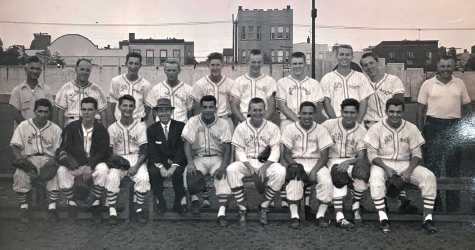
During high school, I played Babe Ruth League, scholastic baseball and Build Better Boys (BBB). BBB was made up of All-Star teams from every city in Hudson County, and it was by far the most enjoyable and competitive. Games were played in the evenings, and we drew good crowds. We traveled to away games in an open city dump-truck, fitted with long benches on the sides of the truck’s bed. If there had been an accident we would have all died. The only walk-off hit I ever delivered came against West New York in extra innings. I’d started the season 0 for 10. My coach, Nick Mastorelli, sent me to the plate with a pat on the butt and these words: “Frankie, get a hit.” The pitcher blew two fastballs by me, but then got cute and threw a high change-up. I jumped on it, lining a single over third base, driving in the winning run for my first hit of the season. The first line of the story in the Hudson Dispatch the next day was “Frankie Foerster was the toast of Union City today.” I finished that season hitting .293, and we won the league.
 In 1961, Roger Maris and Mickey Mantle went after Babe Ruth’s record of 60 home runs. There was a four game series between the Yankees and Detroit in late September with the pennant on the line. My father worked for Turner Construction and he scored me a company box seat ticket down the 3rd base line. Detroit was 1½ games behind to start the series. Yankee Stadium was packed to the rafters. In the ninth inning, with Detroit leading 5-4, Mantle came to the plate and hits his second homer of the game to tie it up. When he hit that ball into the right field stands, the crowd rose as one—the memory of it still gives me goosebumps. Elston Howard won that game with a 3 run homer, Detroit left New York 4½ games behind and out of the pennant race. Mantle later said he had a hangover that day, swung easier, and didn’t try to overpower the pitches.
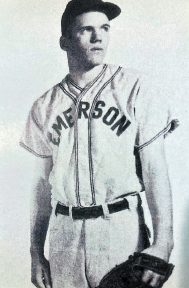
In 1965, as a senior the University of Vermont, baseball beckoned me again, tried out, and made the team. Our coach, Ralph LaPointe, had played briefly for the Phillies. He was a hard-nosed baseball man who smoked a cigar, knew the game and could teach baseball. I loved learning the game from him. I worked my way into the starting lineup, but my almost 4-year absence from the game took its toll and I didn’t hit very well. We tied for the Yankee Conference title, but missed the chance to go to the college world series by losing a playoff against Connecticut.
Once I graduated college, I joined the Peace Corps and wound up in a desolate Indian village, Phagi, about 40 miles outside of Jaipur. There was no running water, no electricity, and had zero sports equipment for the kids. One night, my Peace Corps roommate Mary and I were invited to a small dinner in Jaipur, given by the director of the CARE office. Also In attendance was the striking, jet-setting, world famous Maharani of Jaipur, sporting a diamond ring bigger than my knuckle. Over dinner, I lamented the total lack of sports equipment in Phagi, and the next week, a jeep arrived in the village, and the maharani’s driver delivered a bag cricket bats and balls, which made my heart ache for a box score, any box score.
I didn’t have another significant baseball moment until 2001, in San Francisco, right after 9/11. I scalped a ticket to mostly-empty Candlestick Park, and witnessed Barry Bonds clobber his 64th into the San Francisco Bay, on his way to breaking all the homer records with 73. He had the most compact swing I ever saw. In 2006, I went to a college game in my home-town of Austin: the University of Texas vs Boston College. It was the regional championship game, and Texas won 3 to 2. It wouldn’t have been such a big deal if the game hadn’t lasted 25 innings, and lasted from 6 pm until 1:05 the next morning; the longest game in college baseball history. A Texas reliever, Austin Wood, threw 12 ½ innings of no-hit ball. Cedric Golden, a sports writer for the Austin-American Statesman wrote: “The Disch was packed for the first pitch, and it remained packed until the last out. These fans were buzzed for the entire seven–hour affair. Each time Texas took the field in the extra frames, they rose in unison. Whenever Longhorn pitchers came within one strike of getting out of a jam, they stood as one.” Both teams received a standing ovation at the end of the game. My friend, Bill Jobe, who’s a bigger baseball fan than I am, wanted to leave in the 17th inning, but I said “No way.” When I finally arrived home, my wife told me she thought I’d died.
Over my lifetime, I’ve gone to many games with scores I don’t remember, but players I do, including Ted Williams, Carl Yastremski, Mark McGuire, Derek Jeter, and Alex Rodriguez.
Last October, Bill and I saw Carlos Correa hit a walk off homer against the Yankees in Houston. Wth the now-revealed Astros sign stealing scandal, I wonder if that was a tainted tater. In Field of Dreams, Moonlight Graham says baseball represents all that is good in America. Nah, its just America, with the good and the bad. Still, the game has given me many great moments. And I’ll continue to read
box scores until the end of my days.